Table of Contents
Open Table of Contents
- Trust, But Verify: A Survival Guide for AI-Generated Modern C++
- Why Verification Hits Different in C++
- The Theory, Briefly
- Layer 0: The Compiler Is Your First Code Reviewer
- Layer 1: clang-tidy, the “Stop Writing 2011” Enforcer
- Layer 2: Sanitizers—The Reason I Sleep at Night
- Layer 3: Fuzzing, Because Your Imagination Is the Bottleneck
- Layer 4: Property-Based Testing
- Layer 5: Compile-Time Proofs and Formal-Enough Methods
- Domain Playbooks
- Compiler Support and Portability: The Fine Print
- Letting AI Verify AI (Carefully)
- The FastCodeGuru Pipeline
- Conclusion
Trust, But Verify: A Survival Guide for AI-Generated Modern C++
Last month I asked an LLM to write me a lock-free SPSC ring buffer for a market data feed handler. What came back was gorgeous. Cache-line padding with alignas(64). A comment citing Dmitry Vyukov. A little ASCII diagram of the head and tail pointers. It passed every unit test I threw at it.
It was also catastrophically wrong. The model had used volatile std::uint32_t for the head and tail indices—an idiom from 2009-era blog posts that does absolutely nothing for thread synchronization—and where it did use atomics, it used memory_order_relaxed on operations that needed acquire/release semantics. The code worked in my single-threaded backtest harness for a week. ThreadSanitizer found the data race in under four seconds:
WARNING: ThreadSanitizer: data race (pid=48231)
  Write of size 4 at 0x7f1c4c00 by thread T1:
    #0 RingBuffer<Trade>::push(Trade const&) ring_buffer.hpp:41
  Previous read of size 4 at 0x7f1c4c00 by main thread:
    #0 RingBuffer<Trade>::pop(Trade&) ring_buffer.hpp:52
That’s the whole story of AI-generated C++ in one anecdote. The code looked like it was written by someone who’d read Sutter’s lock-free series. It had absorbed the aesthetics of expertise without the substance. And in C++, the gap between “looks right” and “is right” is where your production system goes to die.
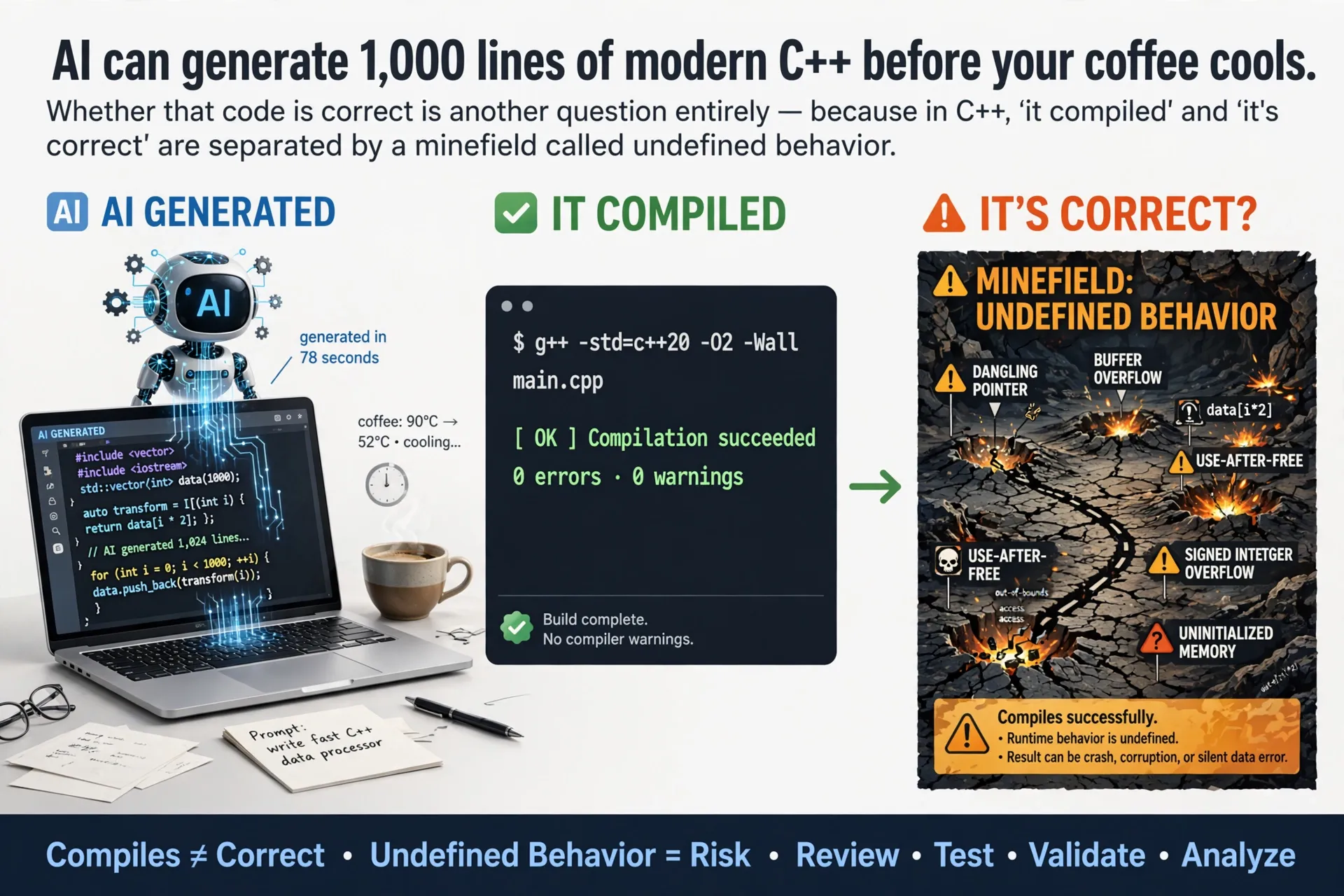
In last week’s Python piece I argued that Python’s dynamic nature makes AI-generated code dangerous because it fails late and loudly. C++ has the opposite problem: it fails silently, sometimes for years, and then the compiler—acting perfectly within its rights—deletes your safety checks because you accidentally gave it permission to.
Why Verification Hits Different in C++
Let’s start with the uncomfortable numbers. The classic NYU study Asleep at the Keyboard? (Pearce et al., IEEE S&P 2022) prompted GitHub Copilot to complete 89 security-sensitive scenarios and found roughly 40% of the 1,689 generated programs were vulnerable. But here’s the number that should keep C++ developers up at night: when they broke it down by language, C was the worst—50.3% of generated C programs contained a CWE, and over half the scenarios had a vulnerable top-scoring suggestion. The closer you get to memory management, the worse the model performs. C++ inherits every one of those failure modes and adds template metaprogramming hallucinations on top.
Meanwhile, the Stanford study by Perry et al. (CCS ‘23) found that developers with AI assistants wrote significantly less secure code—and were more confident it was secure. That combination is toxic in any language. In C++ it’s a liability with a core dump attached.
Why is C++ uniquely exposed?
- There is no runtime safety net. Python raises an exception when you index past a list. C++ hands you undefined behavior, and undefined behavior doesn’t mean “it crashes.” It means “the compiler may now assume this never happens and optimize accordingly.” John Regehr’s guide to UB and Chris Lattner’s classic three-part series remain required reading.
- The blast radius is enormous. Microsoft’s MSRC has said roughly 70% of their CVEs are memory-safety issues; Chromium reports the same ~70% figure for its serious security bugs. These are the best-resourced engineering teams on the planet writing human-reviewed C++. Your LLM is not better than them.
- The failures are spectacular. On July 19, 2024, a single out-of-bounds read in CrowdStrike’s kernel-mode sensor—triggered by a field-count mismatch between a content validator and the content interpreter—bricked roughly 8.5 million Windows machines. That wasn’t AI-generated code. It’s what human-written C++ does when verification has gaps. Now generate that code at 10x speed.
And the institutional pressure is real. The White House ONCD’s 2024 report Back to the Building Blocks explicitly called out memory-unsafe languages; CISA’s joint guidance pushed memory-safe roadmaps; DARPA launched TRACTOR to machine-translate legacy C to Rust. You don’t have to agree with the politics to read the writing on the wall: if you stay in C++ (and for performance work, I am absolutely staying), your verification story is your compliance story.
The Theory, Briefly
Same spectrum as the Python article, different weapons:
| Verification Level | What It Proves | Cost | C++ Tooling |
|---|---|---|---|
| Compiler diagnostics | Syntax, suspicious semantics | Free (compile time) | -Wall -Wextra -Wconversion, /W4 /analyze |
| Static analysis | Bug patterns, guideline violations | Seconds–minutes | clang-tidy, Cppcheck, PVS-Studio, CodeQL |
| Dynamic analysis | Memory/UB/race errors on executed paths | 2–15x runtime | ASan, UBSan, TSan, MSan |
| Fuzzing | Robustness against adversarial input | CPU-hours | libFuzzer, AFL++, OSS-Fuzz |
| Property-based testing | Behavioral invariants (statistical) | Seconds–minutes | RapidCheck, Catch2 generators |
| Formal methods | Bounded or full correctness proofs | Hours–days | CBMC, KLEE, constexpr evaluation, C++26 contracts |
Two things are different from managed languages, and both matter. First, C++ gives you a verification layer nobody else has: the type system and constant evaluation. A static_assert is a proof that runs at compile time and costs nothing at runtime. Second, C++ requires more layers, because no single layer catches UB reliably. Static analysis reasons about all paths but drowns in false positives; sanitizers are precise but only see paths you execute; fuzzing explores paths you didn’t think of but never terminates. You need the sandwich.
Layer 0: The Compiler Is Your First Code Reviewer
The cheapest verification in existence is turning on warnings, and AI-generated code needs them more than most, because LLMs love patterns that trip exactly the warnings people leave off. My baseline, wired up as a CMake interface target:
add_library(project_warnings INTERFACE)
target_compile_options(project_warnings INTERFACE
  $<$<CXX_COMPILER_ID:GNU,Clang,AppleClang>:
    -Wall -Wextra -Wpedantic -Wconversion -Wsign-conversion
    -Wshadow -Wnull-dereference -Wdouble-promotion -Wformat=2
    -Wimplicit-fallthrough -Werror>
  $<$<CXX_COMPILER_ID:MSVC>:
    /W4 /WX /permissive- /analyze>)
Teachable Moment: Warnings are free static analysis. In February 2014, Apple shipped an SSL/TLS verification bypass caused by a duplicated goto fail; line—the infamous goto fail bug. The second goto fail was unreachable code. Clang’s -Wunreachable-code flags exactly this. A multi-year, planet-scale certificate-validation hole, detectable by a warning that costs zero dollars. (Nuance for your toolchain matrix: GCC’s -Wunreachable-code is famously unreliable and was effectively abandoned, which is one reason I always build with at least two compilers.)
Two caveats. One: -Werror in CI, yes; -Werror in code you ship as source, no—new compiler versions add new warnings and your users’ builds break for reasons that aren’t bugs (the OpenSSF hardening guide says exactly this). Two: warnings differ between GCC, Clang, and MSVC. A warning-clean Clang build tells you nothing about what MSVC’s /analyze will say. Carmack was preaching static analysis back in the id Tech days; when the guy who wrote the Doom engine tells you tooling beats discipline, listen.
Layer 1: clang-tidy, the “Stop Writing 2011” Enforcer
LLMs are trained on the internet’s C++, which means their center of mass is somewhere around C++14 with a long tail of raw new/delete, owning raw pointers, NULL, and C-style arrays. clang-tidy is how you mechanically push generated code into the modern era. My .clang-tidy for AI-heavy projects:
Checks: >
  bugprone-*, concurrency-*, cppcoreguidelines-*, misc-*,
  modernize-*, performance-*, portability-*, readability-*,
  -modernize-use-trailing-return-type,
  -readability-magic-numbers,
  -cppcoreguidelines-avoid-magic-numbers
WarningsAsErrors: 'bugprone-*, concurrency-*'
The checks that earn their keep on LLM output specifically: cppcoreguidelines-owning-memory (raw owning pointers), bugprone-suspicious-string-compare, bugprone-unused-return-value (models love ignoring [[nodiscard]]-worthy return values), concurrency-mt-unsafe (AI reaching for std::localtime in threaded code), and the whole modernize-* family. Pair it with the C++ Core Guidelines as your house style and a good chunk of “AI idiom drift” gets caught in seconds.
Layer 2: Sanitizers—The Reason I Sleep at Night
If you take one thing from this article: no AI-generated C++ gets merged without a sanitizer-clean test run. This is non-negotiable in my consulting engagements. The lineup:
| Sanitizer | Catches | Typical Overhead | Availability | Mutually Exclusive With |
|---|---|---|---|---|
| ASan | Heap/stack/global overflow, use-after-free, double-free | ~2x CPU, 2–3x RAM | GCC, Clang, MSVC (/fsanitize=address, since VS 2019 16.9) | TSan, MSan |
| UBSan | Signed overflow, bad shifts, misalignment, null deref, OOB | Small; some teams ship it | GCC, Clang (not MSVC) | Combines fine with ASan |
| TSan | Data races | 5–15x | GCC, Clang on Linux/macOS (not Windows) | ASan, MSan |
| MSan | Uninitialized reads | ~3x | Clang, Linux only; needs instrumented libc++ | ASan, TSan |
| HWASan | ASan’s hardware-assisted cousin | Lower RAM | ARM64/Android | ASan |
CMake plumbing for a target:
# One configuration per sanitizer run — they do not all mix
target_compile_options(feed_handler PRIVATE
  -fsanitize=address,undefined -fno-omit-frame-pointer)
target_link_options(feed_handler PRIVATE
  -fsanitize=address,undefined)
Don’t forget the standard-library hardening layer, which catches AI-generated iterator abuse that sanitizers miss:
- libstdc++:
-D_GLIBCXX_ASSERTIONS(cheap, ABI-safe). Gotcha: its bigger sibling_GLIBCXX_DEBUGis not ABI-compatible—mix translation units built with and without it and you get ODR violations and corrupt containers. Keep it to whole-program debug builds. - libc++:
-D_LIBCPP_HARDENING_MODE=_LIBCPP_HARDENING_MODE_EXTENSIVE(see the libc++ hardening docs). C++26 formalized this idea as “standard library hardening,” turning library precondition violations into contract violations. - MSVC: debug iterators are on in Debug, but watch for
_ITERATOR_DEBUG_LEVELmismatches when linking libraries—linker error LNK2038 exists because everyone hits this eventually.
And that signed-overflow check the AI wrote for you?
bool add_would_overflow(int a, int b) {
    return a + b < a;  // UB on overflow; compilers may legally fold this to false
}
UBSan flags it at runtime; the fix is __builtin_add_overflow on GCC/Clang. Teachable Moment: the optimizer is not your enemy, but it is a literalist. Signed overflow is UB precisely so the compiler may assume it never happens. A check written in terms of the thing it checks is no check at all.
Layer 3: Fuzzing, Because Your Imagination Is the Bottleneck
Unit tests check inputs you thought of. Fuzzing checks inputs you didn’t. For any AI-generated parser—and LLMs generate an endless supply of parsers—wire up a libFuzzer target immediately:
extern "C" int LLVMFuzzerTestOneInput(const std::uint8_t* data, std::size_t size) {
    if (size < sizeof(ItchHeader)) return 0;
    auto msg = parse_itch_message(data, size);  // AI-generated
    if (msg) assert(msg->quantity <= kMaxOrderQty);
    return 0;
}
Build it with clang++ -g -O1 -fsanitize=fuzzer,address,undefined fuzz_itch.cpp itch_parser.cpp and walk away. The last time I did this for an AI-generated ITCH parser, ASan produced this in ninety seconds:
==21987==ERROR: AddressSanitizer: heap-buffer-overflow
READ of size 4 at 0x602000002034 thread T0
    #0 parse_itch_message itch_parser.cpp:38
Test unit written to ./crash-9f3a2c
The model trusted a length field inside the packet. Of course it did. This is not exotic: OSS-Fuzz has found over 13,000 vulnerabilities and 50,000 bugs across 1,000+ projects as of May 2025, the majority of them in C/C++ code. Fuzzing at this point is table stakes. For CI, ClusterFuzzLite or cifuzz give you short fuzz runs per pull request; keep long runs for nightly infrastructure. Windows note: -fsanitize=fuzzer needs clang-cl—MSVC proper only ships ASan.
Layer 4: Property-Based Testing
Same pitch as the Python article, C++ flavor. RapidCheck is the QuickCheck-derived option:
rc::check("order serialize/deserialize round-trips",
  [](const Order& o) {
      RC_ASSERT(deserialize(serialize(o)) == o);
  });
When it fails, it shrinks to a minimal counterexample instead of burying you in noise. RapidCheck’s upstream is quiet these days—forks keep it alive, and Catch2’s generators cover simpler cases—but the technique matters more than the tool. Teachable Moment: properties are executable specifications. “Round-trip is identity,” “output is sorted,” “no funds are created or destroyed”—when you can state one of these, you’ve documented intent in a way an LLM (or a new hire) can’t misread. Which, honestly, is why property tests are also such a good prompting tool: stating the property precisely is half the spec.
Layer 5: Compile-Time Proofs and Formal-Enough Methods
This is where C++ gets to flex. First, the cheapest trick in the book—constexpr golden vectors:
constexpr std::uint32_t crc32(std::string_view data);  // AI's "optimized" CRC32
static_assert(crc32("123456789") == 0xCBF43926);        // the standard check vector
If the model’s CRC is wrong, the build breaks. It can never regress silently. And here’s the part I drill into my tutoring students: constant evaluation is a UB detector. Anything undefined—overflow, out-of-bounds, type-punning through reinterpret_cast—is a hard error at compile time during constant evaluation. Running your algorithm through static_assert on representative inputs is a poor man’s formal verification, and it’s free at runtime.
Second, the big news: contracts are in C++26. P2900 survived a genuinely contentious process—the final poll was 114–12–3—and with C++26 technically wrapped in March 2026 (see Herb Sutter’s trip report), contracts are real:
double position_value(double qty, double price)
  pre(qty >= 0.0)
  pre(price > 0.0)
  post(r : r >= 0.0);
Preconditions, postconditions, and contract_assert in the body, with build-selectable semantics: ignore, observe, enforce, quick_enforce. Enforce in CI, observe in staging, quick-enforce in production. GCC 16 has it merged (check __cpp_contracts); Clang’s implementation is working through upstreaming per the compiler support matrix. This is the verification story of the decade for our language—finally, machine-checkable intent in the source itself.
Third, for the genuinely paranoid: CBMC does bounded model checking on C and a C++ subset—it’s been battle-tested on AWS infrastructure code. And a cultural note: the compiler-writer community verifies GCC and Clang with Csmith, a random program generator that’s found hundreds of bugs in both. If the people who write the compilers verify them with differential and random testing, your AI-generated hot path deserves the same respect.
Domain Playbooks
Finance: Overflow, Determinism, and the Ghost of Knight Capital
The canonical C++-adjacent finance disaster predates LLMs: Knight Capital, August 1, 2012, $440 million gone in about 45 minutes because a repurposed flag reactivated dead code and one of eight servers didn’t get the deployment. The lesson transfers directly: verification must cover configuration and deployment state, not just source. My finance rules for AI code:
- UBSan in CI, always. A former colleague at a prop shop told me their AI-generated order book passed every unit test—until UBSan flagged signed overflow in a P&L accumulation path that only triggered on a 27-fill partial-execution sequence. Their backtests had never hit it because the backtest harness clipped fills. The sanitizer didn’t care about their assumptions.
- TSan with a threaded stress harness. Same shop, same story as my ring buffer: their backtest was single-threaded, so the race was invisible until paper trading. Test concurrency as concurrency.
- Golden vectors and differential testing. Keep a naive, obviously-correct reference implementation. Diff the AI-optimized version against it on exchange conformance feeds and recorded production traffic. Exchanges hand you certification suites for a reason.
- Reproducibility gates. Same feed, same seeds, bitwise-same decisions. Nondeterminism in a backtest is a race condition until proven otherwise.
Game Development: Hallucinated APIs and Save-Game Landmines
A friend who runs a mid-size studio gave me my favorite C++ grounding-error example. Their AI assistant, asked for component lookup code in a UE5 project, confidently produced:
// AI-generated for a UE5 project
TArray<UActorComponent*> Comps =
    Actor->GetComponentsByClass(UStaticMeshComponent::StaticClass());
That’s an API from the UE4 era, long gone in UE5—the model blended engine versions because its training data blended them. Worse, AI-generated Unreal code routinely stores raw UObject* pointers without UPROPERTY(), which works until the garbage collector eats the referenced object three levels deep into a boss fight. Unreal’s reflection system means static analyzers only see half the semantics; your real verification is building against the exact engine version, on the exact toolchain, per target.
The good news: Epic officially documents Clang sanitizers in Unreal—-EnableASan, -EnableTSan, -EnableUBSan, -EnableMSan through UnrealBuildTool. The honest gotcha, confirmed by Epic staff in their forums: on Windows, ASan is a supported workflow for game/client targets, not the Editor. Plan your CI accordingly.
One more landmine, because AI reaches for it constantly:
struct SaveHeader { std::uint32_t magic; std::uint16_t version; /* ... */ };
std::fwrite(&header, sizeof(header), 1, f);  // padding, endianness, ABI: pick your poison
Teachable Moment: structs are not file formats. sizeof includes padding, padding contents are indeterminate, and layout isn’t guaranteed across compilers or -m32/-m64. Serialize field by field, or use a real serialization library. And if you work on console titles: SDKs are under NDA, which means near-zero training data, which means the hallucination rate there is the highest in the industry. Compile against the real SDK and lean on vendor certification suites. Full stop.
Systems & Embedded: Where C++ Verification Was Born
Embedded folks have lived this movie. The Toyota unintended-acceleration litigation made public what Michael Barr’s analysis called spaghetti firmware riddled with MISRA violations—including a stack overflow from recursion and global-state chaos. That case is why we have MISRA C++:2023 (which folded in AUTOSAR C++14) and CERT C++. If an LLM generates firmware code, run it through a MISRA checker before a human even reads it; AI output is spectacularly non-compliant by default.
Bare-metal gotchas I enforce mechanically: the build must link with -fno-exceptions -fno-rtti if that’s your house rule (AI loves exceptions); new and malloc are CI errors if you’re static-allocation-only; and then there’s my favorite portability trap:
char c;
while ((c = port.read()) != -1) { /* ... */ }  // works on x86, loops forever on ARM
Teachable Moment: char signedness is implementation-defined. Signed on x86, unsigned on ARM by default. The AI learned this code from x86 tutorials. Your STM32 build doesn’t care what the AI learned.
Compiler Support and Portability: The Fine Print
AI models generate code for an idealized “modern C++” that no single compiler fully implements. Rough minimums as of mid-2026 (always verify against cppreference before committing):
| Feature | GCC | Clang | MSVC |
|---|---|---|---|
| Concepts (C++20) | 10 | 10 | 19.23 |
| Ranges | 10 | 13, mostly by 16 | 19.29 |
std::format | 13 | 14 (libc++; solid by 17) | 19.29 |
std::expected | 12 | 16 | 19.33 |
std::print | 14 | 18 (libc++) | 19.39 |
| Contracts (C++26) | 16 | upstreaming | not yet |
Note the asterisk that ruins roadmaps: Clang’s library features depend on which standard library you pair it with—libstdc++, libc++, or MSVC STL—and they differ in SSO sizes, container growth strategies, debug checks, and header dependency graphs. Guard speculative features with feature-test macros (__cpp_lib_format, __has_include(<print>)), and make your CI matrix match your deployment reality: GCC and Clang on Linux, MSVC on Windows, Apple Clang on macOS, plus an ARM64 lane if you ship to Graviton, Apple Silicon, or mobile. -Werror portability cuts both ways—one compiler’s new warning is another team’s broken build—so pin toolchains and upgrade deliberately, not accidentally.
Letting AI Verify AI (Carefully)
The most interesting development since my Python article: AI is getting genuinely good at finding bugs, which means the sanitizer-and-fuzzer stack above can be partially AI-built. Google’s LLM-driven fuzz-target generation found 26 vulnerabilities in OSS-Fuzz projects, including an OpenSSL out-of-bounds bug (CVE-2024-9143) that had likely sat there for two decades beyond the reach of human-written harnesses. Project Zero’s Big Sleep caught a real SQLite vulnerability before release.
But watch the full arc, because Daniel Stenberg lived it in public on the curl project: first came the flood of AI-slop vulnerability reports that nearly broke his security team and contributed to curl shutting down its bug bounty in February 2026—and then, months later, a new breed of AI-powered analyzers started filing real, high-quality reports, curl’s confirmed-vulnerability rate is now back above pre-AI levels. Same technology, opposite outcomes, difference entirely in the verification rigor behind it. My rules: AI may draft fuzz harnesses and property tests, but the harness must compile, must actually kill mutants (see below), and a different model plus deterministic tooling reviews the output. The model that wrote the bug shares blind spots with the model reviewing it.
The FastCodeGuru Pipeline
- Generate into quarantine. AI output lands in
ai-drafts/, neversrc/. Prompt with constraints: “C++20, no owning raw pointers,std::spanfor buffer views, exceptions for errors, no C arrays.” - Seconds gate: warnings-as-errors + clang-tidy. Failure here costs nothing and catches the 2011-isms.
- Minutes gate: unit tests under ASan+UBSan; a TSan job for anything touching threads.
- Nightly: fuzz runs, property tests, an MSan job if you’re on Clang/Linux,
_GLIBCXX_DEBUGfull-program build. - Weekly: CodeQL or PVS-Studio deep pass; mutation testing with Mull to verify your tests actually detect sabotage;
llvm-covcoverage as a test-quality signal. - Human review, on semantics. The machine checked the syntax. You check intent: are the invariants right? Is this the correct algorithm? Does the error-handling policy match the system?
# The matrix is the message
strategy:
  matrix:
    include:
      - { os: ubuntu-latest, cxx: g++-14,    build: Debug,   sanitizers: "address,undefined" }
      - { os: ubuntu-latest, cxx: clang++-19, build: Debug,  sanitizers: "thread" }
      - { os: ubuntu-latest, cxx: clang++-19, build: Release, sanitizers: "address,undefined" }
      - { os: windows-latest, cxx: cl,        build: Debug,   sanitizers: "address" }
      - { os: macos-latest,  cxx: clang++,    build: Debug,   sanitizers: "address,undefined" }  # ARM64 lane
Opinionated Rant: “It compiles” in C++ is not the finish line—it’s the handshake. The language hands the optimizer a license to exploit every assumption you didn’t write down, and LLMs write down almost nothing. If your verification pipeline isn’t faster than your generation pipeline, you’re not engineering; you’re typesetting.
Conclusion
The compilers get better every year—C++26 contracts, hardened standard libraries, sanitizers on every major platform—and the models get better every quarter. Neither trend removes the gap between plausible and provable; if anything, faster generation widens it. The C++ developers who thrive in this era will be the ones whose verification stack runs at machine speed: warnings and clang-tidy in seconds, sanitizers in minutes, fuzzers overnight, contracts and static_assert proofs baked into the source itself. Trust the output. Verify everything. And when an AI hands you a lock-free queue with a nice ASCII diagram, reach for ThreadSanitizer before you reach for the merge button.
I teach this exact pipeline—sanitizers, fuzzing, and property-based testing for C++ teams—in my tutoring and consulting practice. If your team is adopting AI-assisted C++ and wants the guardrails built in from day one, get in touch.